
Governments that do not respect central banks' independence will sooner or later incur the wrath of the financial markets, ignite economic fires, and come to rue the day they undermined an important regulatory institution; their wiser counterparts who invest in central bank independence will enjoy lower costs of borrowing, the love of international investors, and longer life spans, said Acharya, who will return to the New York University's Stern Business School in August.

In the Sensex pack, M&M was the biggest loser, tumbling by 6.66 per cent, followed by TCS dropping 4.14 per cent.

'There are deeper, underlying, forces at work and we need institutional arrangements to guard against them.'
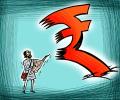
Barry Eichengreen, professor of economics and political science, University of California, Berkeley, analyzes the transparency of the Reserve Bank of India, the growth rate of the Indian economy and why he feels globalisation can never be rolled back.

Rajan said the process of dialogue with the government did not reach a stage where he could have agreed to stay on

Will seek to bring inflation to the mid-point: Rajan

Terming the RBI action on Wednesday as a "pleasant surprise", analysts today cautioned that possibility of a rate hike in the future cannot be ruled out. Urijit Patel committee's report on monetary policy would clear the air on RBI's future stand, they added.

The US Federal Reserve has said economic activity is improving while deciding to continue with the near-zero interest rate regime to bolster the economy.

'India is not so distant from years of high and entrenched inflationary expectations that it should start trying to play games with the economy the way the West's central bankers think they are entitled to,' argues Mihir S Sharma.

However, it may still not change its stance on the policy rate as inflationary pressures are coming from high commodity prices.

During March, the rate of inflation slowed to the weakest in four months and was below the long-run survey average

The government has no plan to print currency notes to tide over the current economic crisis triggered by the outbreak of COVID-19 pandemic, Finance Minister Nirmala Sitharaman informed Parliament on Monday. To a question on whether there is any plan to print currency to tide over the crisis, the finance minister said, "No Sir". Many economists and experts have suggested to the government to print more currency notes to tide over the difficult economic situation with a view to support the economy ravaged by the spread of COVID-19, and protect jobs.

The Reserve Bank is working on a phased implementation strategy for its own digital currency and is in the process of launching it in wholesale and retail segments in the near future, RBI Deputy Governor T Rabi Sankar said on Thursday. He said the idea of Central Bank Digital Currency (CBDC) is ripe, and many central banks in the world are working towards it. Sankar further said CBDC is needed to protect consumers from the "frightening level of volatility" seen in some of the virtual currencies which have no sovereign backing.

Inflation targeting has worked well and the government must stay with it, and the framework is going to work well in the period ahead also, former RBI Governor D Subbarao said on Thursday. He also said low inflation contributes to sustainable growth. Addressing the 'Times Network India Economic Conclave' virtually, Subbarao said the government's proposal to privatise some public sector units is not akin to selling family silver but it is a route for putting India on a sustainable growth path.

Shifting its stance of monetary policy towards targeting retail inflation as it is an "inequitable tax", RBI today said it may exceed 8 per cent by March end and efforts will continue to bring it down.

It's crucial for Modi to make India an easier place to do business.

The report said that "we believe, institutions are more important than individuals" and ultimately what is important is the credibility and the independence of any institution and nothing else.

Costlier vegetables slowly pushed retail inflation, which had remained well within the Reserve Bank's comfortable level of 4 per cent during most part of 2019, peaked to more than three-year high of 5.54 per cent in November.

The broad market depicted strength. 1,525 shares rose and 1,131 shares fell. A total of 156 shares remained unchanged

If the concerns over risking political capital are overcome, the long-term gains for the Indian economy will be immense, asserts A K Bhattacharya.

As he projected a grim outlook for the economy, RBI Governor said that amidst this encircling gloom, agriculture and allied activities have provided a beacon of hope on the back of an increase of 3.7 per cent in foodgrains production to a new record.
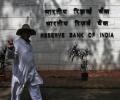
The supply-side driven inflationary pressures, from food or fuel prices, would be mitigated by a neutral stance and a prolonged pause on rates, says Gaurav Kapur.

The government plans to bring down its stake to 26 per cent in these two banks, which are yet to be identified. This may not come in the way of getting investors for these banks, provided the government is willing to step back rather than run them the way it had been doing for over five decades since these banks were nationalised, points out Tamal Bandyopadhyay.

The Reserve Bank of India is expected to announce a slew of measures to bring vibrancy into the debt market as part of its mid-term review of the annual monetary policy.

Rate cuts are unlikely to be aggressive, in our view.
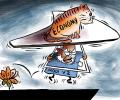
The reform priorities are clear: enhance savings, improve productivity. Just 25 basis points of moving interest rate up or down would not boost investment: Former RBI Governor Y V Reddy.

Rajan had overturned the majority opinion of the members and chose to hold the rates at the last monetary policy review in October.

It is the six per cent target RBI is more concerned about.

He will be the eighth Deputy Governor to be made Governor at RBI

Currency scarcity weighed on manufacturing performance where growth of new work flows slowed

Despite admitting to price pressures both from food items and input prices, RBI Governor Shaktikanta Das on Wednesday hoped that a normal Southwest monsoon will have a "soothing impact" on inflation pressures and ruled out any wide variations in medium-term inflation forecast from what was given in April. In an unscheduled address earlier in the day amidst the raging pandemic, Das said the overall outlook for the economy is highly uncertain and is clouded with downside risks. He offered a slew of relief and liquidity measures to individuals and small businesses apart from a Rs 50,000 crore special liquidity window to the healthcare sector.

Reserve Bank, in its mid term review of the monetary policy on Friday, decided to hike short term policy rate by 0.25 per cent after a gap of two years and ease liquidity by reducing the marginal standing facility rate for banks.

The Reserve Bank of India (RBI) on Wednesday announced an extension of interim ways and means advances (WMAs) limit of Rs 51,560 crore to state governments till September, to help them tide over the financial stress posed by the second wave of COVID-19. WMAs are temporary advances given by the RBI to the states to tide over any mismatch in receipts and payments. There are two types of WMA - normal and special. While normal WMA are clean advances, special WMA are secured advances provided against the pledge of the government of India dated securities.

The size of the hole in today's banking crisis appears to be roughly 10 per cent of GDP.

Achieving inflation target of 4 per cent, recovery after remonetisation and hardening profile of oil prices are some of the risks which the RBI is watching closely, says Gaurav Kapur.
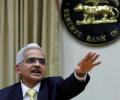
Probably in August. We can argue whether RBI is dovishly neutral or neutrally dovish but the telltale signs of at least one more rate cut are strewn all over the policy statement, points out Tamal Bandyopadhyay.
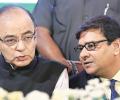
'For the RBI, for a central bank, reputational risk is the worst risk.' 'Credibility is the worst risk,'
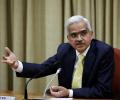
The government on Wednesday asked the Reserve Bank to maintain retail inflation at 4 per cent with a margin of 2 per cent on either side for another five-year period ending March 2026. To control the price rise, the government in 2016 gave a mandate to the RBI to keep the retail inflation at 4 per cent with a margin of 2 per cent on either side for a five-year period ending March 31, 2021.
'There are deliberations on whether there can be lowering of income taxes and other sops to keep more money in the hands of taxpayers, enabling them to spend more and boost demand.'

Prices of food articles contracted by 3.47 per cent in June on a yearly basis. Vegetable inflation stood at (-)21.16 per cent.
